
Sine USDC Lending (SOL)
Actively managed USDC lending across Solana DeFi protocols, with automated rebalancing to pursue net yield within portfolio risk, concentration and liquidity limits.
Overview
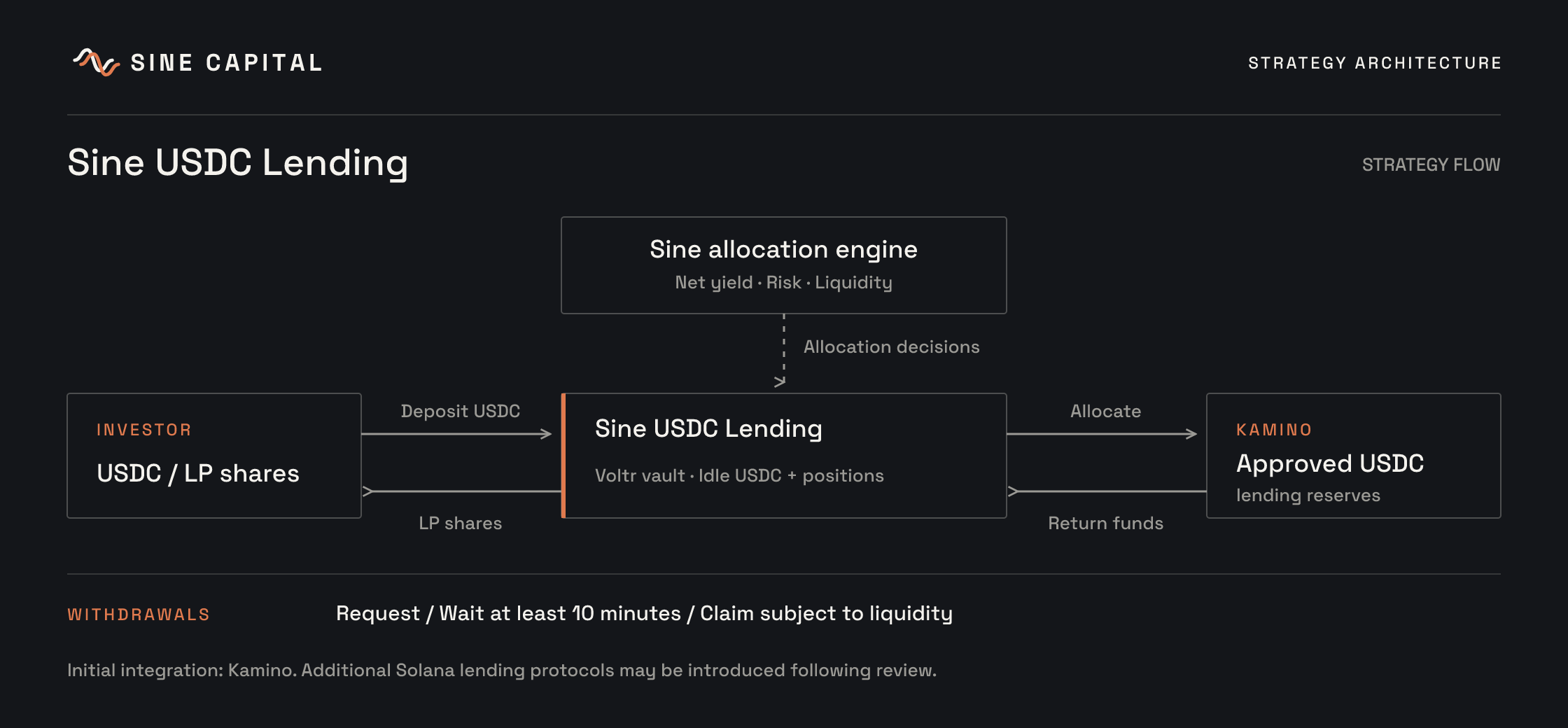
Section titled “Overview”Sine USDC Lending is a USDC-denominated vault managed by Sine Capital using Voltr infrastructure.
The strategy allocates capital to approved lending markets, seeking interest income while managing portfolio risk and withdrawal liquidity. The initial integration covers selected USDC reserves on Kamino. Additional Solana lending protocols may be introduced following a review of their risks, accounting and execution mechanics.
The initial strategy does not borrow, use leverage or swap USDC into other assets.
| Parameter | Selected configuration |
|---|---|
| Deposit and withdrawal asset | Native USDC on Solana |
| Vault infrastructure | Voltr |
| Initial lending integration | Kamino |
| Deposit capacity | See the live vault page and on-chain configuration |
| Minimum withdrawal waiting period | 10 minutes |
| Locked-profit period | None |
| Sine performance fee | 10% above the high-water mark |
| Sine management, deposit and withdrawal fees | None |
The website display capacity and the on-chain deposit ceiling can differ. The live vault page identifies both; neither is a target allocation or a guarantee that capital can be deployed.
Source of returns
Section titled “Source of returns”Returns come primarily from interest paid by borrowers in the underlying lending markets.
Lending rates vary with borrowing demand, reserve utilization and market conditions. An allocation can itself change utilization and the rate available to the vault. The strategy therefore evaluates the expected return at the proposed position size rather than relying solely on the rate displayed before deployment.
USDC held outside lending positions does not earn lending interest. Maintaining withdrawal liquidity or reducing exposure can lower portfolio returns. There is no fixed or guaranteed yield.
Allocation and rebalancing
Section titled “Allocation and rebalancing”The allocation process evaluates:
- Expected lending income at the proposed position size.
- Borrower and collateral exposure under stress scenarios.
- Available withdrawal liquidity and deployment capacity.
- Concentration across reserves and shared risk exposures.
- Data freshness, execution costs and existing withdrawal requests.
A market must have sufficient information for assessment and a verified execution route before it becomes eligible for allocation. Availability through an adapter does not automatically qualify a market for investment.
The manager first reserves liquidity for investor withdrawal requests and checks whether existing exposure requires a protective reduction. It then seeks to place available USDC in eligible markets. Deploying idle capital is evaluated separately from moving an already invested position: a switch-cost filter must not by itself leave new deposits unused. Existing connected markets are considered before routes that require additional setup.
For discretionary switches, the optimizer compares expected income at the proposed position sizes over a seven-day planning horizon, allowing for modeled execution costs and a minimum improvement. This is a bounded search over candidate allocations, not a guarantee of the best possible future return. Rates, risk estimates and liquidity can change before execution.
Current operating parameters
Section titled “Current operating parameters”Verified against the production manager configuration on 3 November 2026:
| Control | Current setting |
|---|---|
| Portfolio stress-loss budget | 7% of vault assets under the supplied scenarios |
| Maximum capital in one reserve | 70% |
| Normal idle target ceiling | 1% of vault assets, plus pending investor withdrawal liabilities |
| Operating liquidity buffer | 1% of assets, with a 1 USDC minimum |
| Routine allocation minimum move | 0.10 USDC |
| Planning horizon | 7 days |
| Market and allocation check cycle | Approximately 30 seconds |
| Scheduled recorded-position refresh | Approximately 10 minutes; additional refreshes before movements |
The minimum cash buffer, execution minimums, retained position balances and pending withdrawals can make the 1% idle ceiling infeasible, especially for a small vault. It is a target-search constraint, not a promise that cash will remain below 1% at every instant. If no eligible allocation satisfies the controls, or the search cannot establish one within its limit, the manager reports that condition rather than relaxing risk limits automatically.
New allocations normally leave 1% of the configured stress budget unused as a margin for accrual and rounding: at a 7% budget this corresponds to a 6.93% target. An existing portfolio within the hard budget is not sold solely to create this margin.
Routine movements retain a small balance in each existing position (currently approximately 0.01 USDC) to avoid repeatedly closing and recreating accounts. Actual investor withdrawal liabilities can use this remainder when necessary. Protective reductions seek to remove the amount needed to restore the risk target, subject to liquidity and retained balances, rather than automatically closing a whole position.
Data and execution failures
Section titled “Data and execution failures”Fresh market readings and economic position values are used for allocation checks independently of the less frequent paid accounting refreshes. Missing or expired risk evidence blocks new risk-taking; it does not by itself trigger a liquidation or replenishment of the discretionary idle buffer. Funding actual investor withdrawal requests remains a priority.
The executor checks transaction funding, including account-creation costs and a minimum SOL reserve, before preparing a sequence of movements. Preparation failures are recorded across restarts. Insufficient funding waits for changed funding conditions; other preparation failures use a retry delay. Scheduled accounting refreshes can continue during such a hold, while repeated movement-driven preparation is suppressed. Pending transactions must be reconciled before further execution.
Risk management
Section titled “Risk management”The strategy combines scenario analysis, concentration controls and liquidity assessment when selecting allocations.
The 7% budget limits modeled losses in the supplied scenarios. It is not a maximum possible loss, insurance or a probability estimate. A complete market or protocol failure, USDC impairment, an oracle failure or an unmodeled event can cause substantially larger losses, including total loss. The 70% capital cap does not mean that risk contributions are evenly distributed.
Positions in different reserves can depend on the same collateral, oracle, protocol or source of liquidity. Spreading capital across reserves does not necessarily diversify those risks.
When known risk conditions deteriorate, the response is to reduce exposure where an executable exit is available. If only a partial withdrawal is possible, the remaining position continues to carry risk.
Stale or incomplete information can prevent new allocations. Protective actions remain subject to the information and liquidity available at execution time. These controls cannot eliminate losses or ensure that portfolio risk remains within intended limits during stressed conditions.
Deposits, shares and withdrawals
Section titled “Deposits, shares and withdrawals”Investors deposit USDC and receive Voltr LP tokens representing a proportional interest in the vault. The value redeemable per LP token reflects portfolio performance, applicable fees and the vault’s accounting rules. LP tokens do not represent a fixed USDC balance.
Withdrawals use a request-and-claim process with a minimum waiting period of 10 minutes. Once that period has elapsed, the investor can attempt to complete the withdrawal.
Ten minutes is the earliest claim time, not a guaranteed settlement deadline. Completion depends on available USDC, underlying market liquidity and the return of funds from lending positions. The end of the waiting period does not automatically unwind those positions.
The liquidity process prioritizes withdrawal requests over new allocations. Delays can occur during market stress, protocol interruptions or operational failures.
The selected locked-profit period is zero, so the vault does not apply an additional time-based profit-smoothing window.
Fees and expenses
Section titled “Fees and expenses”Sine Capital’s selected performance fee is 10% of eligible profits above the high-water mark, the historical peak asset value per LP token used by Voltr’s fee accounting.
Following a decline below that mark, performance must recover above it before further performance fees become payable under that mechanism.
Sine Capital charges no separate annual management, deposit or withdrawal fee.
Operating expenses
Section titled “Operating expenses”Sine Capital covers strategy execution, network and infrastructure expenses from its own capital or income attributable to its own vault position. These expenses are not charged separately to other depositors.
Protocol and underlying market costs
Section titled “Protocol and underlying market costs”Voltr protocol fees and costs embedded in underlying lending markets are separate from these operating expenses. Any applicable Voltr protocol fees will be disclosed after verification of the vault’s on-chain configuration and before investor onboarding. A zero Sine management fee does not establish a zero total protocol management fee.
Infrastructure and permissions
Section titled “Infrastructure and permissions”Voltr provides the vault and LP accounting, Kamino provides the initial lending markets, and Sine manages allocation and execution. See permissions and governance for the administrative powers, manager authority, protocol dependencies and audit scope.
Principal risks
Section titled “Principal risks”Investors may lose part or all of their capital. Lending, collateral, liquidity, stablecoin, contract and operational risks apply. The vault’s lack of borrowing does not remove exposure to leveraged borrowers in its underlying markets. Read the vault risk summary.
Transparency
Section titled “Transparency”Vault and LP token addresses, active integrations, applicable fees and operating information are the basis for investor reporting.
The live vault page shows recorded fee-adjusted vault assets and trailing historical APY with 24-hour, 7-day and 30-day viewing windows. Observations are normally collected approximately every five minutes. Asset growth includes deposits; APY is calculated from fee-adjusted share value so deposits are not treated as income. The APY history chart plots the trailing 24-hour estimate at each recorded point, using shorter available history when necessary.
Missing observations are disclosed rather than fabricated. Historical charts remain visible when observations are stale, while the current APY is withheld. See shares and accounting for the calculation and freshness rules. Historical results, modeled allocations and advertised market rates are distinct; none guarantees future returns.
Protocol references
Section titled “Protocol references”Investor guide
Section titled “Investor guide”Read the Legal disclaimer alongside this strategy description.