Market Structure
Volume is not liquidity
Two markets can report the same daily volume and offer very different execution. A worked example shows why depth matters more than a headline number.
Daily volume tells you how much traded over a period. It does not tell you how much you can buy or sell now, at a price close to the current quote.
That distinction matters when comparing venues. A market can be busy throughout the day while offering little resting size when an order arrives.
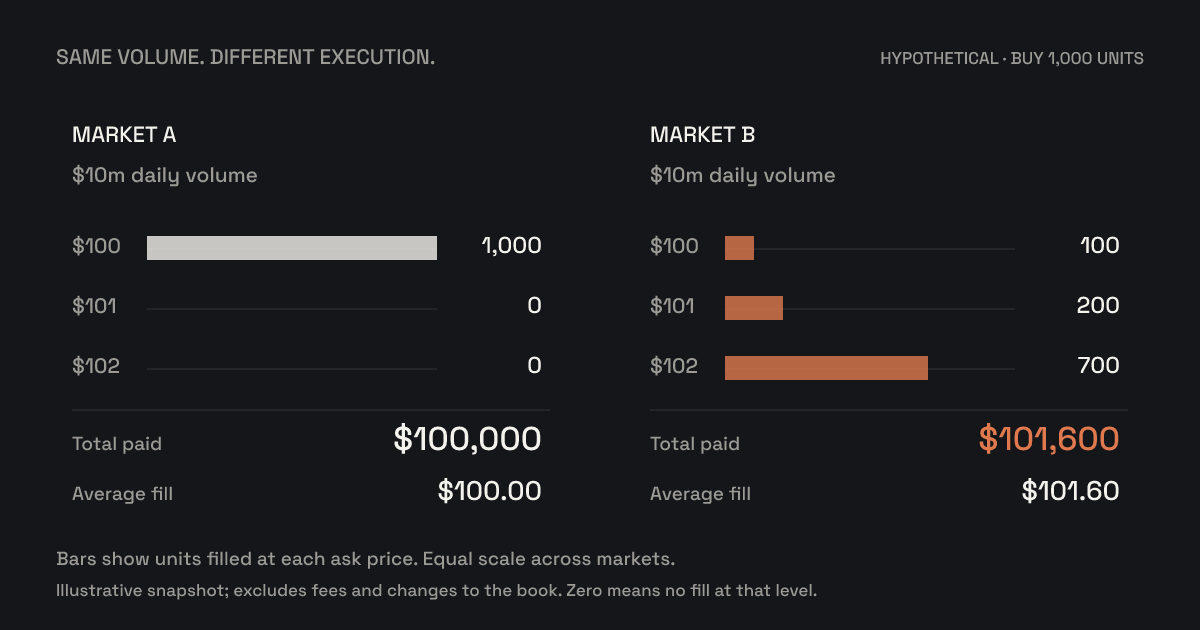
Same volume. Different execution.
Consider two hypothetical markets. Both report $10 million of daily volume. Both show a best ask of $100. You want to buy 1,000 units, with a notional value of $100,000 at that quote.
The available asks look like this:
| Ask price | Market A: units available | Market B: units available |
|---|---|---|
| $100 | 1,000 | 100 |
| $101 | 1,000 | 200 |
| $102 | 1,000 | 700 |
In Market A, the full order fills at $100. Total cost: $100,000.
In Market B, the order buys 100 units at $100, 200 at $101 and 700 at $102. Total cost: $101,600. The average execution price is $101.60, or 1.6% above the initial best ask.
This is an illustrative snapshot, not observed market data. It assumes the displayed orders remain available during execution and excludes trading fees.
Daily volume was identical. The cost of this trade was not.
Liquidity depends on the order
A small order might fill entirely at the best price in either market. A larger order may consume several price levels. The relevant question is therefore specific: how much can this market absorb, on this side of the book, within this price range?
The bid–ask spread describes the gap between the best buy and sell quotes. Depth describes the size available at and beyond those quotes. A tight spread with little size can look attractive until an order reaches the market.
Displayed depth is also a snapshot. Orders can be cancelled, additional liquidity can arrive and prices can change before execution. A deep book is useful evidence, but it is not a guarantee of a particular fill.
Compare the trade you intend to make
A useful comparison looks at estimated execution for a consistent order size, the same side of the market and the same point in time. Add fees to understand total cost. Repeat the observation across different periods to see whether the result holds when conditions change.
Volume remains useful as a measure of activity. For execution, it needs company: spread, depth and the price actually achieved.