Market Structure
A tight spread can be expensive
Compare the cost of buying the same quantity, including fees, rather than ranking markets by the displayed spread.
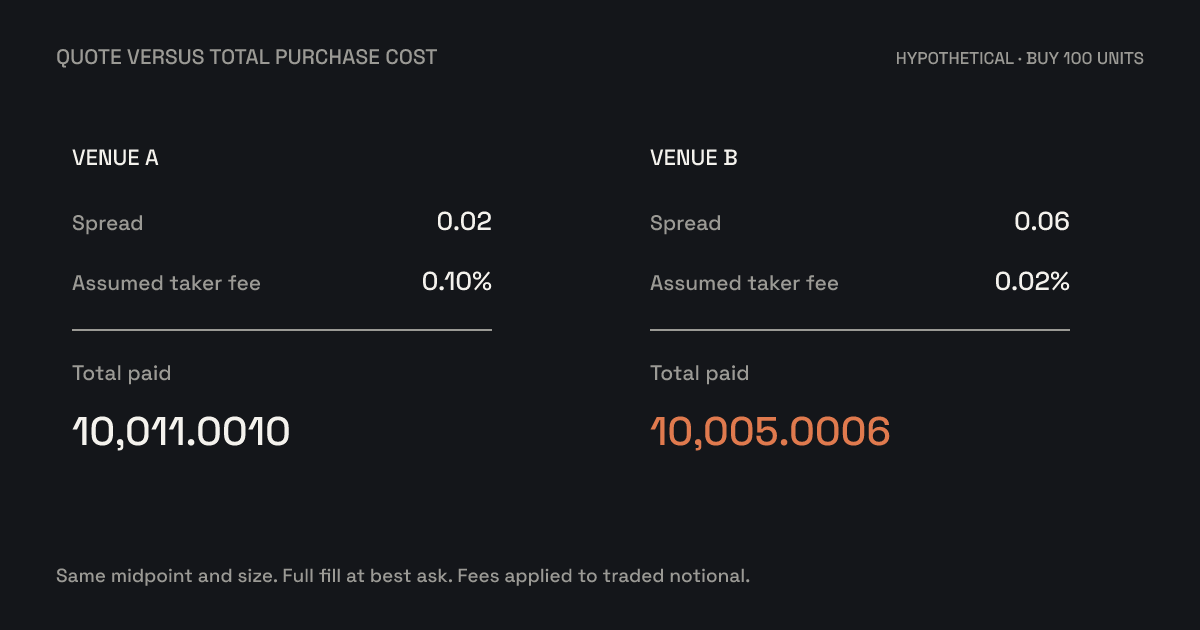
The narrowest displayed spread does not necessarily produce the cheapest purchase. A quote describes a price at a particular size. A trading fee changes the cash paid for the fill.
Those two effects should be evaluated together before choosing a venue.
Compare one decision
Consider a hypothetical purchase of 100 units. Two venues have the same reference midpoint of 100.00, sufficient displayed quantity at their best ask, and immediate full execution. Ignore price changes, transfers and rounding.
| Input | Venue A | Venue B |
|---|---|---|
| Best bid | 99.99 | 99.97 |
| Best ask | 100.01 | 100.03 |
| Quoted spread | 0.02 | 0.06 |
| Assumed taker fee | 0.10% | 0.02% |
| Cost before fees | 10,001.00 | 10,003.00 |
| Fee on traded notional | 10.0010 | 2.0006 |
| Total paid | 10,011.0010 | 10,005.0006 |
All prices, quantities and fee rates are invented for this example. They are not a quote from an exchange or Sine’s fee schedule.
Venue A has the tighter spread. Venue B costs approximately 6.00 less for this purchase because the assumed fee advantage exceeds its worse ask price.
Relative to the common midpoint, the purchase costs approximately 11.00 basis points at A and 5.00 basis points at B. A basis point is one hundredth of a percentage point.
The spread is not the buyer’s entire cost
The quoted spread is ask minus bid. For this buy, the relevant price concession is ask minus the reference midpoint. Charging the full spread again would double-count part of the comparison.
A useful execution calculation starts with the weighted average fill price and adds the actual fee. For a sale, measure proceeds after fees instead. Use one reference price and one observation time across venues.
Size can reverse the answer again
The table assumes all 100 units are available at the best ask. If they are not, the order consumes additional price levels. The weighted average purchase price then replaces the headline ask.
Displayed depth can also change before an order arrives. A comparison of snapshots is an estimate under stated assumptions, not a guarantee of a future fill.
Resting a limit order introduces a different question: whether it fills, when it fills, and what the market does around that fill. A hypothetical maker rebate should not be treated as certain income before execution.
For an actual routing decision, specify quantity, side, reference time, available balances and applicable account fees. The cheapest visible quote becomes meaningful only after those inputs describe the trade that can actually be made.