Market Structure
Your staking yield has an exit cost
Staking APR leaves out the path from an exit decision to usable ETH. Compare waiting, redemption and market-sale costs separately.
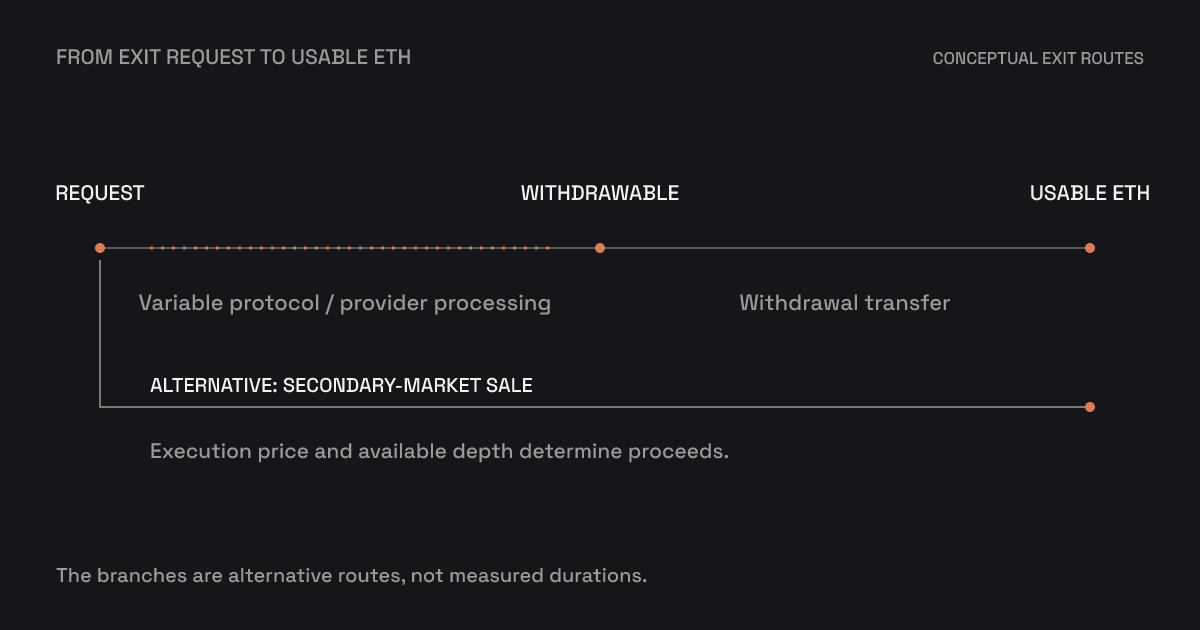
A staking return is earned while capital is committed. Deciding to leave is the start of a process, not necessarily the moment the capital becomes usable.
A comparison that ranks products by displayed APR alone leaves this process out. For an allocator with a deadline, the exit route can matter as much as a small difference in the annual rate.
Three exits that look similar in an interface
The first is a protocol-level validator exit. It changes the validator’s status and eventually allows eligible funds to be withdrawn. The second is redemption through a staking provider, whose own procedures may sit above protocol mechanics. The third is selling a liquid staking token to another market participant.
Ethereum’s withdrawal documentation distinguishes validator withdrawals from provider-specific arrangements. A market sale adds an execution question: what price and size are available when you want to sell?
| Route | What determines usable proceeds? |
|---|---|
| Validator exit | Protocol processing and withdrawal eligibility |
| Provider redemption | Provider terms, liquidity and the underlying withdrawal process |
| Secondary-market sale | Available buyers, spread, depth, fees and token pricing |
These routes are not guaranteed substitutes. A token can be transferable while selling the intended amount at an acceptable price remains difficult.
Compare the cost over your holding period
Suppose two hypothetical routes offer 3% and 4% annual rates. On 100 ETH, the one-percentage-point advantage over 30 days is about 0.082 ETH, using simple accrual and a 365-day year.
Now assume the higher-rate position would cost 0.20 ETH more to exit through the chosen route. That cost is larger than the illustrative 30-day rate advantage. It is a scenario, not an observed discount or a statement that one staking product is better.
The comparison must also treat the waiting period consistently. Rewards may accrue differently across stages, fees may differ, and a later market price is unknown. Do not assume either continuous rewards or zero rewards throughout an exit without checking the mechanism.
Time, price and access are separate dimensions
A queue affects timing. A secondary-market discount affects the price obtainable. A provider restriction affects access. Combining them into one generic “liquidity risk” label hides which condition could prevent your plan from working.
For a practical comparison, record an intended exit amount, the route available to your account, its current conditions, and the time by which proceeds are needed. Recheck these conditions near execution; a queue estimate or displayed quote is not a reservation.
Staking also involves validator, contract and provider risks, depending on the route. This article does not estimate those risks or claim any particular historical queue duration.
The relevant return is the result over a specified holding and exit period. A higher annualised rate needs enough time, and a workable exit, to become a better outcome.