Developments
A stablecoin launch is not distribution
USDG’s launch and network announcement illustrate why issuance, access and repeat usage require different evidence.
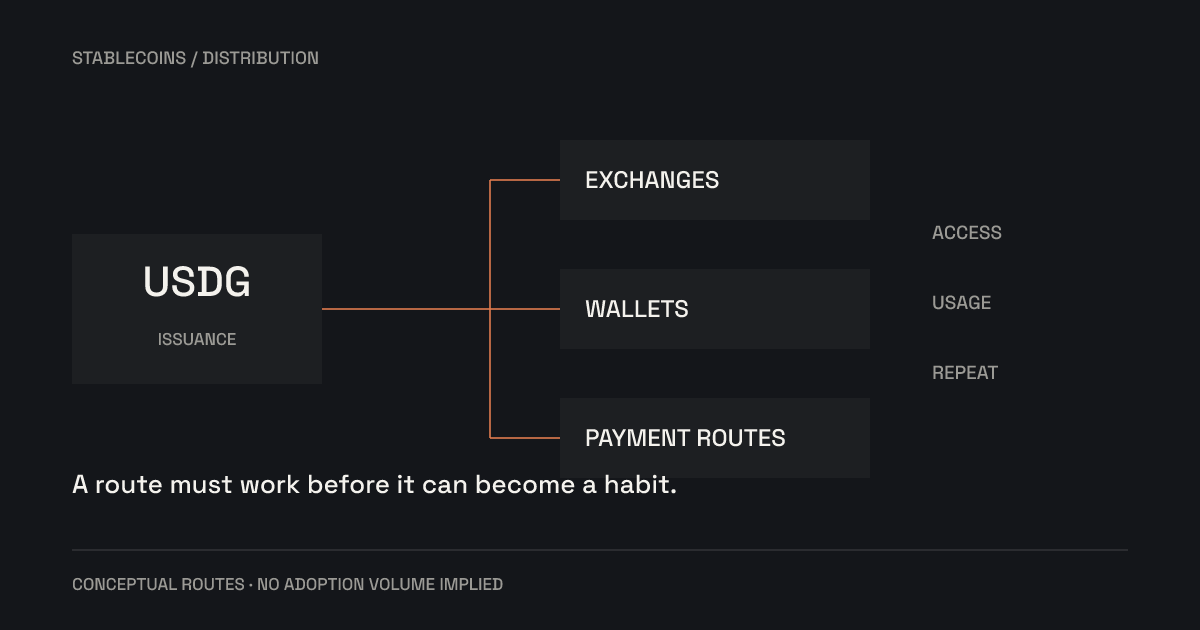
A stablecoin can be issued before it has a useful distribution network. A network can be announced before its members generate repeat payment demand. Treating those stages as equivalent makes adoption seem easier to measure than it is.
USDG offers a useful dated example. Paxos’s release carried a 1 November 2024 Singapore dateline and named Paxos Digital Singapore as issuer. It said USDG was available on Ethereum and described plans for wider distribution. The original release establishes what was announced at launch, rather than how extensively it was subsequently used.
A second announcement addressed distribution
A separate release, dated 5 November 2024 in its Singapore dateline, introduced Global Dollar Network. It named seven initial partners and described incentives intended to encourage participation. The page’s metadata displays the previous calendar day; the dates here follow the releases’ explicit datelines.
Crucially, the network announcement distinguished USDG access on named venues at launch from future availability across all named distribution partners. Membership in the announcement was not evidence that every partner already offered the same customer route.
That is a useful distinction for reading any multi-company launch. Partner count describes the announced network. Product availability describes a route a user can actually take.
Distribution changes the economics to examine
An issuer needs reserve management and redemption arrangements. A distributor needs a reason to integrate the token, support customers and maintain a route in and out. A user needs a reason to hold or transfer it instead of an existing alternative.
Those interests can align, but the existence of incentives does not measure the resulting demand. Incentivised balances, exchange inventory and repeated customer payments describe different behaviour.
For a follow-up, we would separate three questions:
- Access: which eligible users can obtain, transfer and redeem the token through a named route?
- Usage: which identifiable activities recur, after excluding internal movements where classification is possible?
- Economics: what does the route cost, and which parts of participation depend on incentives?
These are proposed tests, not claims that the launch failed or succeeded. A lack of usage figures in an announcement is an evidence gap, not zero adoption.
Read the launch at its stated stage
The releases support an issuance event and an announced distribution effort. They do not, on their own, establish broad payment adoption or a measured improvement in customer settlement costs.
The question worth carrying forward is which usable routes the network created and whether customers kept using them. That makes the next assessment depend on observed behaviour rather than the number of names in the launch headline.
Archive edition: March 2026. Prepared in October 2026 as an analysis of the November 2024 launch documents. No current market-share or payment-volume claim is made.