Market Structure
Settlement is not finality
A confirmed transaction, a credited platform balance and usable proceeds are different milestones. Trace the full path of a transfer.
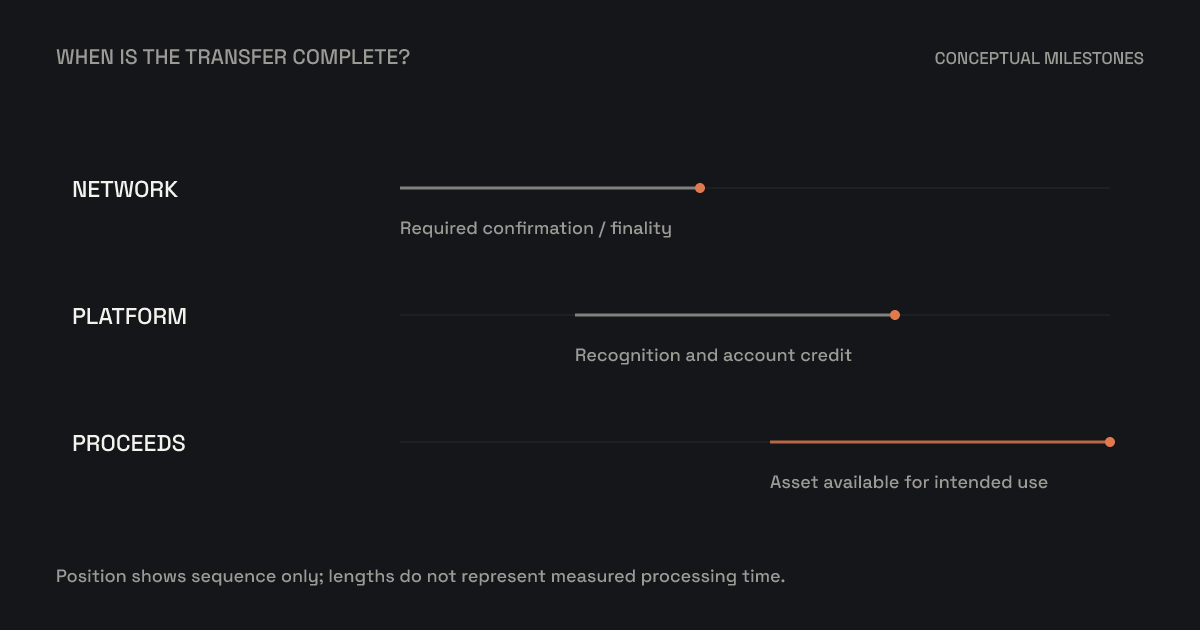
“The transfer completed” can describe different events to the sender, the receiving institution and the eventual user of the funds.
A blockchain transaction may be included in a block while a receiving platform has not credited it. A platform may credit a balance while withdrawals or conversion remain subject to operational conditions. Treating these moments as identical makes speed comparisons unreliable.
Name the completion event
For a hypothetical transfer from one institution to another, identify the asset, the network, the recipient and the obligation being settled. Then distinguish the milestones.
| Milestone | What has happened? | What remains to check? |
|---|---|---|
| Submission | A transaction was sent to the network | Inclusion, acceptance and possible failure |
| Network confirmation or finality | The relevant network condition was reached | The receiver’s recognition and control of proceeds |
| Platform credit | The receiver’s internal account was updated | Conversion, withdrawal and account restrictions |
| Usable proceeds | The required asset is available for its intended use | The specific business obligation and legal context |
Not every transfer uses an intermediary, and some steps may be combined. The point is to define the actual route before attaching a duration to it.
Network and legal questions are distinct
A network has its own rules for confirmation and finality. Ethereum’s proof-of-stake documentation describes how its consensus mechanism treats finality. Another network or a platform’s internal ledger requires a different analysis.
Technical finality does not by itself answer whether a particular commercial obligation is legally discharged. That depends on the arrangement, governing rules and settlement asset. The BIS monetary-system discussion places tokenisation within the broader system of money and settlement rather than treating every token transfer as an identical payment instrument.
Compare the same clock
Suppose one service measures five seconds from network submission to inclusion. Another reports ten minutes from customer instruction to usable bank funds. Those figures have different start and end points; comparing them directly does not show which service is faster for the same task.
A useful comparison records when the instruction became valid, when funding was available, which network condition was required, when the receiver recognised the transfer and when the required proceeds could be used. Fees, failures and out-of-hours conditions belong in the same description.
These milestones are an analytical framework, not measured performance from a live pilot. A specific claim about a production payment route needs evidence for that route and its observation period.
The business benefit of a transfer mechanism depends on the completion event the business needs. Before asking how fast it settles, specify what must become final, for whom, and in which asset.