Market Structure
Oracle prices are not executable prices
A reference price can value collateral without telling you what a position will realise when sold.
A portfolio can be correctly marked and still be expensive to sell. The price used to value an asset answers a different question from the price available for a specific order.
An oracle supplies a reference under a defined methodology. An executable quote adds a venue, direction, quantity and moment. Leaving those fields blank turns a valuation into an assumption about liquidity.
A mark does not reserve a buyer
Chainlink’s feed-selection guidance discusses market-wide pricing, differences between venues and the importance of liquidity. A feed for an underlying asset may also differ from a market in its wrapped representation. Those distinctions matter before any execution calculation begins.
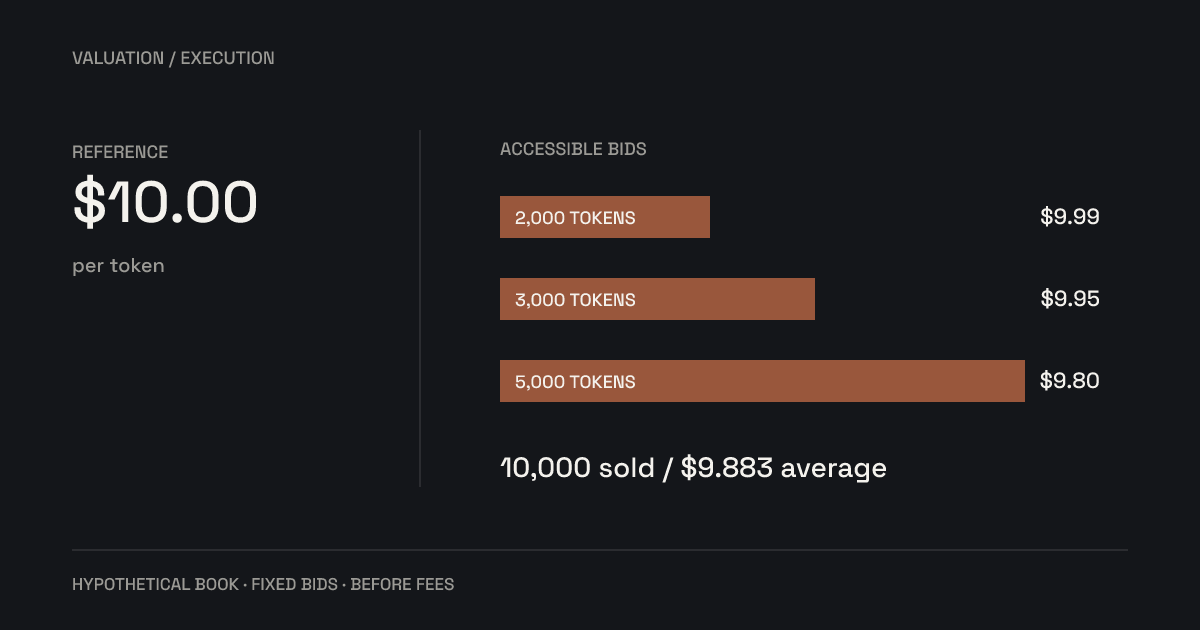
Consider a hypothetical holding of 10,000 tokens marked at $10 each: a $100,000 valuation. Suppose the accessible bids are:
| Tokens sold | Bid price | Proceeds |
|---|---|---|
| First 2,000 | $9.99 | $19,980 |
| Next 3,000 | $9.95 | $29,850 |
| Remaining 5,000 | $9.80 | $49,000 |
Selling the entire holding into that unchanged book produces $98,830 before fees. The average fill is $9.883, or 117 basis points below the reference. The example assumes all displayed bids remain available, with no competing orders, latency or replenishment.
The reference need not be faulty for that difference to exist. A broad market valuation does not commit buyers on one accessible venue to purchase an entire position at the marked price.
Three checks before using the number
First, identify what the feed prices: the exact token, its underlying asset, an exchange rate or another quantity. A wrapper’s redemption relationship and its secondary-market price can diverge.
Second, check freshness against the decision. A value acceptable for periodic reporting may be unsuitable for an urgent liquidation. Update rules and failure handling belong in the assessment of the particular feed and integration.
Third, estimate proceeds for the actual size and route. Include fees, transfer restrictions and whether the asset can reach the venue in time. A deeper market elsewhere helps only if it is accessible within the execution window.
Carry two values
A useful risk report can show both reference value and estimated liquidation proceeds. The first makes positions comparable under a consistent convention. The second asks what cash could be recovered under explicit execution assumptions.
Their difference should be visible. Treating it as zero hides an assumption precisely where position size and market stress make it most consequential.
Archive edition: February 2026. Prepared in October 2026 as a conceptual explainer. The example is hypothetical; linked documentation supports the mechanism, not a historical feed configuration.