Market Structure
Liquidations need liquidity too
Collateral value does not equal cash recovery. A worked example separates a liquidation trigger from the economics of executing it.
Collateral can reduce a lender’s exposure to a borrower. It does not remove the need to execute when a position becomes unsafe.
A liquidation trigger is an accounting or risk condition. Recovering debt is an operational sequence involving funding, collateral transfer and, often, a sale or hedge. The price used to identify the problem is not automatically the price available to resolve it.
A trigger is not an execution quote
Protocols define when a position can be liquidated. Aave’s liquidation documentation, for example, describes health factor and eligible debt repayment. Exact thresholds, close factors and bonuses depend on the protocol and configuration; they should not be assumed universal.
Once eligible, a liquidator must still have access to repayment assets and an acceptable expected outcome. Competition, network conditions, collateral liquidity and other positions becoming liquidatable can affect that outcome.
Follow one hypothetical liquidation
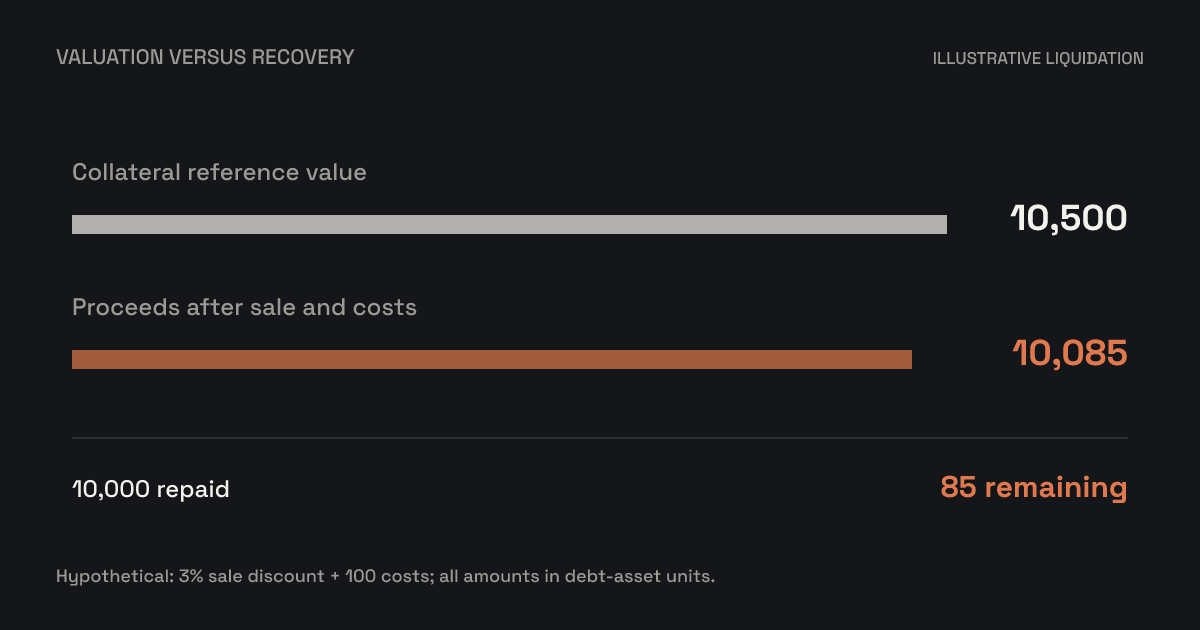
Assume a liquidator repays 10,000 units of a debt asset and receives collateral with a reference value of 10,500 units. For this example only, assume all values are measured consistently in the debt asset and that the specified collateral transfer occurs.
| Step | Amount |
|---|---|
| Debt repaid | 10,000 |
| Reference value of collateral received | 10,500 |
| Proceeds after a 3% sale discount | 10,185 |
| Proceeds after another 100 of transaction and execution costs | 10,085 |
| Illustrative surplus | 85 |
The nominal 500-unit difference is not the realised surplus. At a 5% sale discount, proceeds after the same costs would be 9,875, leaving a 125-unit loss.
This scenario is deliberately simplified. It does not reproduce a live protocol position, flash-loan fee schedule or executable order book. A liquidator could retain or hedge collateral instead of immediately selling it, creating a different exposure.
Correlated demand for exits matters
A collateral asset can trade actively in normal conditions and still face pressure when many positions require liquidation at once. The relevant market is the one available during the liquidation process, at the intended size and within the required time.
This is why a collateral haircut and a liquidation bonus do different jobs. A haircut limits borrowing against a reference valuation. A bonus provides an incentive to perform an eligible liquidation. Neither mechanism supplies an unlimited bid for the collateral.
For a specific assessment, inspect the trigger, repayable amount, collateral received, executable sale or hedge, financing costs and transaction conditions. Reference prices are necessary inputs, but cash recovery depends on the whole sequence.
A lending position can be overcollateralised on a valuation screen while recovery still depends on scarce liquidity. The liquidation mechanism must be evaluated together with the market it would use.