Developments
Pectra changed exit control, not the liquidity question
Pectra changed who can initiate a validator exit. That improves control without establishing an immediate cash exit.
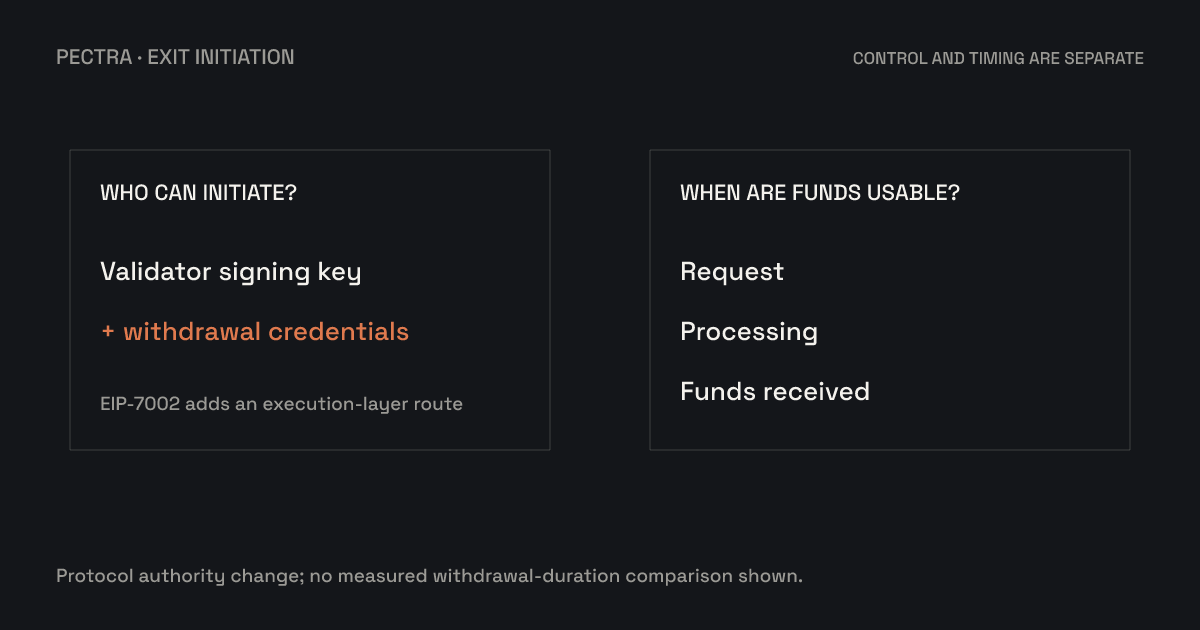
An exit mechanism has two separate properties: who can request an exit, and when the assets become available. Pectra changed an important part of the first question.
The Ethereum Foundation’s April 2025 announcement included EIP-7002, allowing exit initiation through execution-layer withdrawal credentials. Ethereum’s upgrade record confirms activation on 7 May 2025.
The control change
Before this mechanism, initiating a validator exit depended on the active validator signing key. That matters when an operator controls the signing key while another party controls the withdrawal address.
EIP-7002 provides an execution-layer route for the withdrawal-credential holder to request an exit. Its stated motivation includes reducing dependence on the operator and recovering funds when active keys are lost.
How to assess a staking arrangement
Our interpretation is that this changes the due-diligence question. Checking that withdrawals ultimately reach the right address is insufficient; a depositor should also establish who can initiate the process.
For a hypothetical arrangement, map three parties: the person providing capital, the entity operating the validator, and the address or contract controlling withdrawal credentials. They need not be the same entity.
If a contract controls the credentials, inspect the permissions through which a user can cause it to act. A protocol capability does not establish that every customer-facing product exposes that capability to each customer. The practical analysis therefore follows control through the actual arrangement, rather than stopping at the upgrade name.
Measure the outcome separately
A useful follow-up would track request submission, acceptance, exit eligibility and receipt of funds. Compare those timestamps with a clearly defined earlier sample, controlling for queue conditions and the product used.
This article does not contain that dataset. It makes no claim that average withdrawal time fell, that a particular provider adopted the mechanism, or that every staker obtained a direct exit path.
For allocation decisions, keep two fields in the assessment: exit authority and expected access to usable funds. Better authority can reduce one dependency even when the timing still needs a separate estimate.
Archive edition: December 2025. Prepared in October 2026 using the dated announcement and the linked technical records; no historical queue-time finding is asserted.