Market Structure
Different tokens can carry the same risk
Counting token symbols can overstate diversification. Map shared underlying assets, issuers, collateral and infrastructure dependencies.
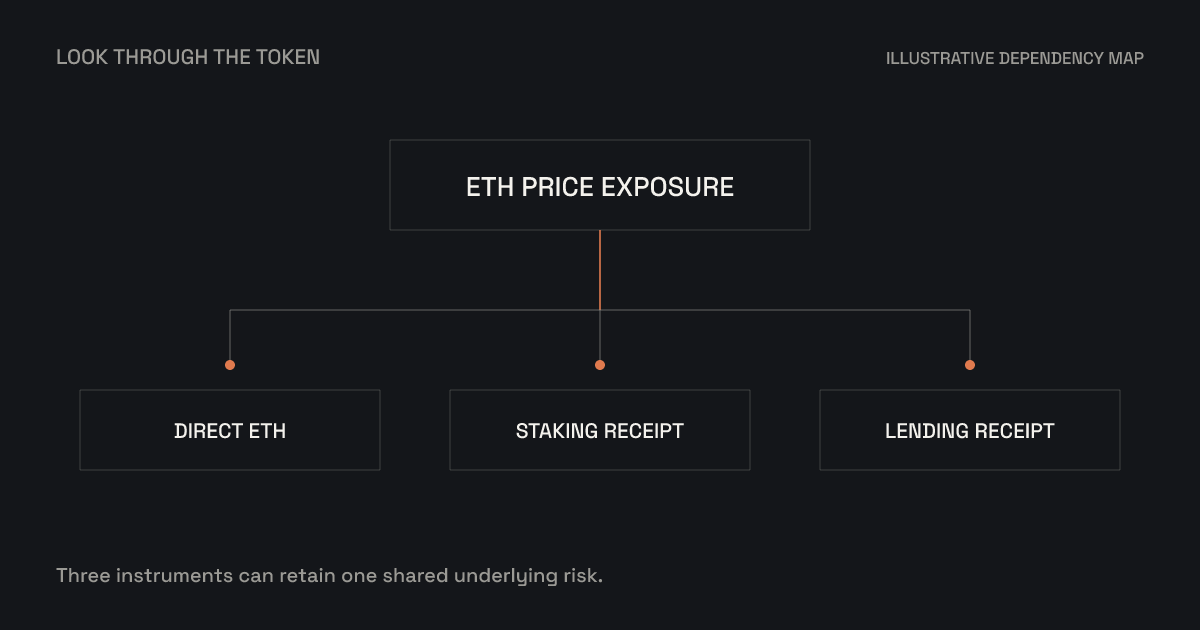
A portfolio with five token symbols can still be dominated by one economic exposure.
The useful unit of diversification is the dependency, not the ticker. Different wrappers or receipt tokens can point back to the same underlying asset, issuer, lending reserve or redemption mechanism.
Look through the wrapper
Consider a hypothetical portfolio with 40 units of direct ETH exposure, 35 units represented by a staking receipt and 25 units represented by a lending receipt on an ETH-linked asset. Assume the units are initial portfolio-value shares, not token quantities.
In a simplified scenario where all three positions move one-for-one with ETH and ETH falls 20%, the portfolio falls 20% before fees and other effects. Holding three instruments has not reduced that common price exposure.
In real products, the wrappers may add basis, collateral, contract and provider risks. Those additional differences can create diversification in one dimension while leaving the main underlying exposure intact. They can also create more ways to lose, rather than a reliable hedge.
Ethereum’s pooled-staking guidance describes approaches that introduce service or smart-contract arrangements beyond solo staking. The right analysis follows the specific product’s mechanics rather than treating every staking token as equivalent.
Build a dependency map
| Dependency | Questions to ask |
|---|---|
| Underlying price | Which asset’s price drives the position’s value? |
| Issuer or provider | Who maintains the claim or operates redemption? |
| Collateral | Which assets support repayment or the receipt’s value? |
| Execution and exit | Which venues or pools must work to realise proceeds? |
| Infrastructure | Which contracts, oracles, bridges and networks are shared? |
A stablecoin held directly and the same stablecoin supplied to a lending protocol share the stablecoin exposure. The lending position adds another layer; it does not remove the issuer or asset dependency. A self-controlled wallet and a platform account can change custody exposure while retaining the same market risk.
Stress the shared failure mode
Ask what happens if the common underlying moves, if a redemption route becomes unavailable, or if several positions need the same exit venue at once. Write the cash-flow path for each position under that scenario.
This does not produce a complete portfolio-risk model. Correlations and liquidity change through time, and a dependency map does not assign probabilities. Its purpose is to prevent instrument count from standing in for exposure analysis.
The practical output is a short list of concentrations that survive the labels. Distinct tokens can be useful tools, but diversification requires sufficiently different economic outcomes under the situations that matter.