Market Structure
Depth recovery needs a clock
A book that looks full again may have recovered at a different price. Define the measurement before timing it.
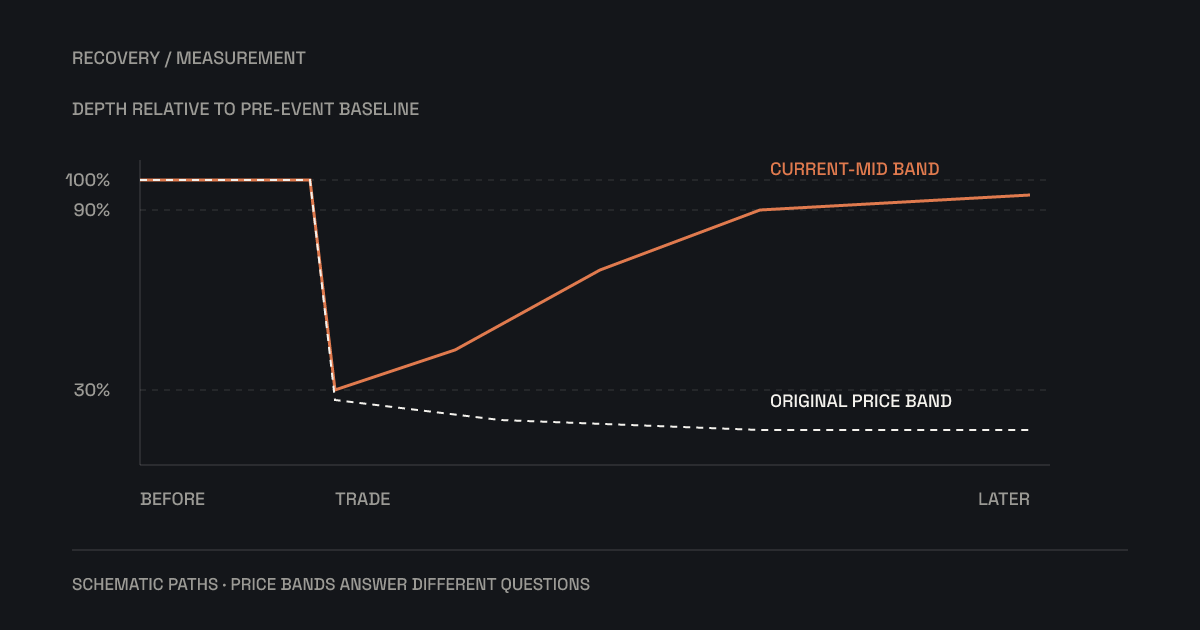
A trade consumes offers. A moment later, new offers appear. Has liquidity recovered?
Only after specifying what counts as recovery. The same book can regain its previous displayed quantity while becoming more expensive for the next buyer. A return of quantity, a return of price and a return of execution quality are different outcomes.
Keep the measuring window consistent
Imagine a hypothetical market with $500,000 of asks within 10 basis points of the midpoint. Immediately after a buy, that depth falls to $150,000. Five seconds later it reaches $450,000, but the midpoint has moved 20 basis points higher.
Relative to the new midpoint, 90% of the original depth is back. For a trader still trying to buy near the original price, the outcome is less reassuring. The measuring window moved with the market.
Neither measurement is inherently wrong. They answer different questions. Depth around the current midpoint describes the current book; depth inside the original price band describes the remaining opportunity at earlier prices. A study should say which it uses.
A workable recovery definition
One possible design would measure ask-side notional within 10 basis points of the current midpoint, compare it with a pre-event baseline, and time the return to at least 90% of that baseline. Requiring the threshold to hold for a defined period would reduce sensitivity to a fleeting quote.
Those are proposed research choices, not industry constants. A one-second persistence requirement and a five-second requirement can produce different answers. So can using the last pre-trade snapshot instead of a median over the preceding minute.
The underlying data must preserve order. Bybit’s order-book documentation distinguishes snapshots from subsequent updates. Missing updates can make a reconstructed recovery appear faster or slower than it was.
The difficult part is selecting events
A large trade may occur during a continuing sequence of aggressive orders. Calling the first refill its recovery ignores the next depletion. Overlapping events need a rule: exclude them, group them or analyse them separately.
A study also needs a control for ordinary book changes. Otherwise a price move and the passage of time can be mistaken for a response to the selected trade. Replenishment alone does not establish who supplied it or why.
What to ask of a headline
Before using a claim that a market recovers in a few seconds, ask for the side, price band, baseline, persistence condition and treatment of unrecovered events. An average calculated only from events that recover can omit the hardest cases.
This article reports no measured recovery time. It defines the questions a credible estimate must answer, so that a visually full book does not become evidence of resilience by default.
Archive edition: February 2026. Prepared in October 2026. All quantities and timings in the example are hypothetical.