Market Structure
A collateral haircut is not an exit guarantee
Borrowing power, liquidation triggers and sale proceeds need separate calculations.
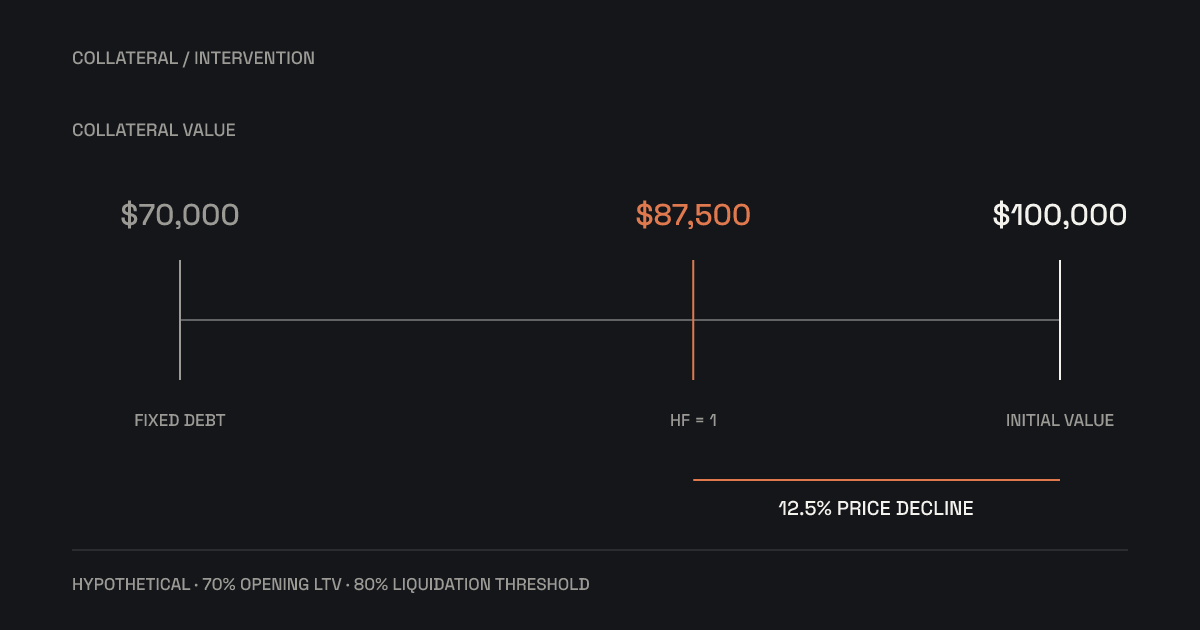
A lender may value collateral at $100,000 and allow only $70,000 of borrowing against it. That gap can look like a comfortable loss buffer. Its usefulness depends on which risk it is meant to absorb.
A haircut reduces recognised collateral value or borrowing power under a specified convention. It does not reserve liquidity for a future sale. A position can respect its opening limit and later become difficult to liquidate.
Separate entry from intervention
Aave’s glossary distinguishes loan-to-value limits from liquidation thresholds. Those settings serve different decisions: how much debt a position may open and when an existing position becomes eligible for liquidation. Actual settings depend on the asset, market and applicable mode.
Use a hypothetical single-collateral position with a 70% opening LTV and an 80% liquidation threshold. Collateral initially marked at $100,000 supports $70,000 of debt. Its simplified health factor is:
Collateral value × liquidation threshold ÷ debt = 1.143.
Holding debt and parameters constant, the health factor reaches 1 when collateral falls to $87,500. That is a 12.5% decline from the initial mark. The opening gap between collateral and debt was 30%, but the price move to the intervention boundary is much smaller.
The trigger still needs an executable market
Now suppose collateral falls to a $90,000 reference value. The simplified health factor remains above 1, at about 1.029. If selling the entire position would incur an 8% discount to that reference, gross proceeds would be $82,800.
That sale discount is another hypothetical assumption, not a prediction about Aave or any named asset. It illustrates a separate calculation. Interest, liquidation incentives, transaction costs and the protocol’s actual liquidation mechanics would need their own treatment.
A liquidation threshold can respond to risk without guaranteeing the amount obtainable from a sale. Conversely, a deep market at entry does not guarantee the same depth after a sharp move.
Read the buffer in units of stress
A useful collateral assessment starts with the opening limit, then calculates the price move to the intervention boundary under explicit assumptions. It should also estimate proceeds under a plausible sale size and horizon.
For multiple assets, correlations and weighted thresholds add complexity. Debt can grow through interest or change in value, while governance can change parameters. The simple calculation above freezes those variables to make the distinction visible.
The practical question is how much time and executable value remain when intervention begins. A percentage labelled “haircut” cannot answer both on its own.
Archive edition: March 2026. Prepared in October 2026. All parameters and stress figures are hypothetical, not historical settings for a named reserve.