Market Structure
A $1 token is a claim on whom?
Compare the issuer, redemption route and custody behind a stablecoin, a tokenised deposit and an exchange dollar balance.
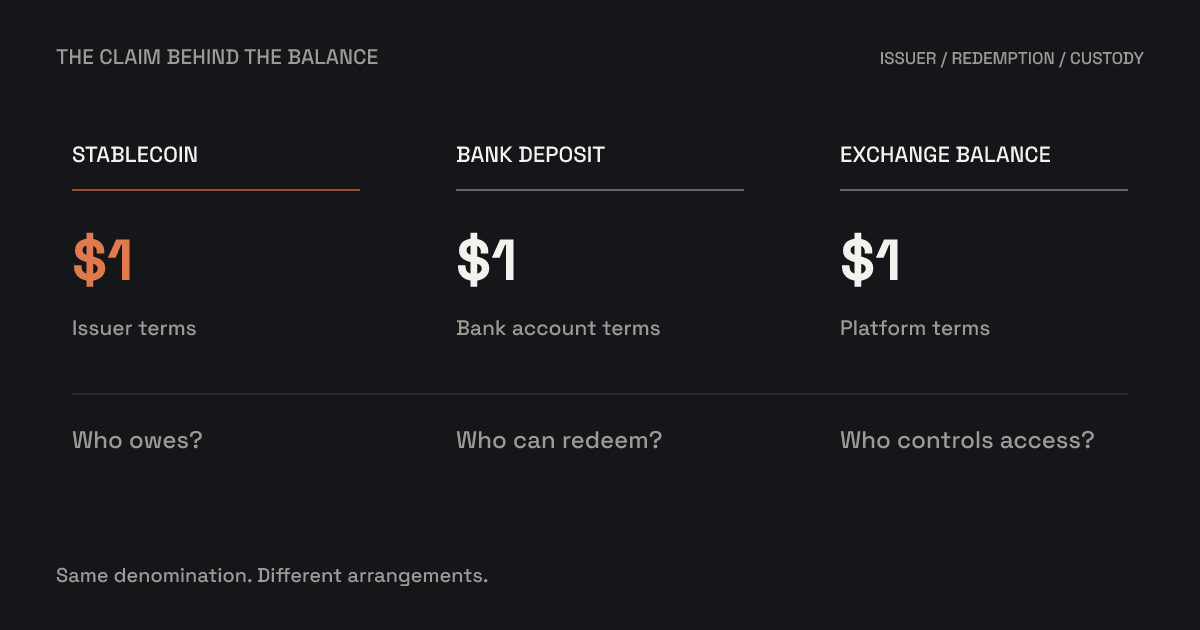
A dollar symbol describes a unit of account. It does not identify who owes you money, who controls the asset, or how you turn the balance into something you can spend.
Those distinctions matter when three interfaces all display “$1”. A stablecoin, a tokenised bank deposit and a dollar balance on an exchange can have different issuers, access conditions and custody arrangements. Comparing the displayed price alone misses the structure of the claim.
Start with the debtor
For a bank deposit, the relevant liability is generally the deposit-taking bank’s obligation to the account holder. Representing that deposit with a token changes the recording or transfer mechanism; it does not automatically turn it into central bank money. The BIS discussion of tokenisation distinguishes the instruments and their role in settlement.
For an issuer-backed stablecoin, the analysis starts with the issuing entity, reserve arrangements and applicable terms. Token ownership and direct access to issuer redemption are separate questions. A holder may depend on an exchange or another intermediary to obtain fiat even when an eligible direct customer can redeem with the issuer.
An exchange balance requires a different first question: what exactly does the balance represent? A fiat cash balance, a stablecoin balance and a platform’s internal dollar-denominated credit should not be treated as interchangeable. The relevant agreement determines the relationship.
Separate three layers
| Layer | Question | Why it matters |
|---|---|---|
| Issuance | Who is responsible for the instrument? | Identifies the entity and underlying arrangement to investigate |
| Redemption | Who can exchange it for what, and under which conditions? | Determines whether you have a direct route or rely on an intermediary |
| Custody | Who controls the wallet, account or withdrawal process? | Identifies an additional access dependency |
Consider a hypothetical holder buying a dollar token through a trading platform. The token’s issuer and the platform are different entities. If the holder leaves it on the platform, withdrawing depends on that platform’s controls as well as the token’s design. Moving it into a self-controlled wallet changes the custody layer, but does not rewrite the issuer’s redemption terms.
A secondary-market sale is a different exit
Selling a token for dollars on a venue is a trade. Redeeming it with the issuer follows a contractual and operational route. They can produce similar outcomes in normal conditions while having different fees, eligibility requirements and failure points.
Circle’s USDC terms, for example, distinguish eligible direct-redemption customers from other holders. Product terms and jurisdiction must be checked when making a specific comparison; the example does not establish identical rights across stablecoins.
A useful instrument comparison therefore records the debtor, redemption asset, eligible redeemer, custody provider and available exit routes. Deposit protection, segregation and insolvency treatment require their own jurisdiction-specific review. A shared dollar denomination cannot answer those questions.